A personal reason to build it
I live with diabetes and use a FreeStyle Libre 2 Plus. That makes glucose information part of everyday life, but finding an application that helps me calmly understand the data, rather than simply collect it, has been harder than it should be.
I wanted a product that combined a functional and visually thoughtful interface with a lighter interaction model, including a virtual companion that responds to the moment. The goal was never to make health data less serious; it was to make the recurring act of returning to it feel clearer and more human.
A focused personal-health problem
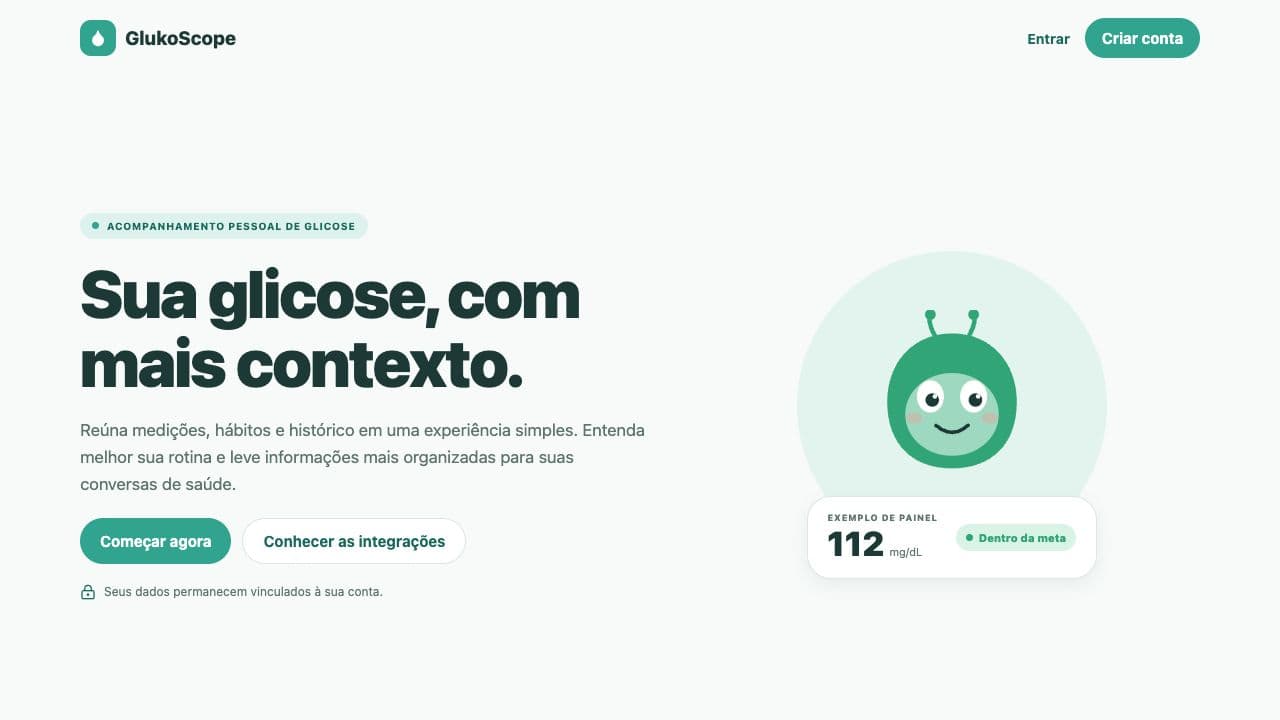
GlukoScope began with a simple observation: glucose readings are useful, but a number on its own rarely explains enough. The product is designed as a personal record that brings measurements, habits and history into one calmer place, so people can recognize their own routine and have better-organized conversations with health professionals.
That framing matters. GlukoScope is not a primary monitoring device, a diagnostic tool or a source of treatment recommendations. It deliberately helps people understand their personal record without turning health data into clinical advice.
Context before complexity
The dependable starting point is manual entry. A measurement can be recorded with its value, time, target range, context and note, including moments such as fasting, meals, exercise and sleep. This makes the history more useful without requiring an external connection before someone can begin.
The experience then turns that record into a clear dashboard, chronological history and daily or weekly views. The intention is not to add another dense health dashboard; it is to make it easier to return to the information and notice patterns over time.
A dashboard for returning to the data
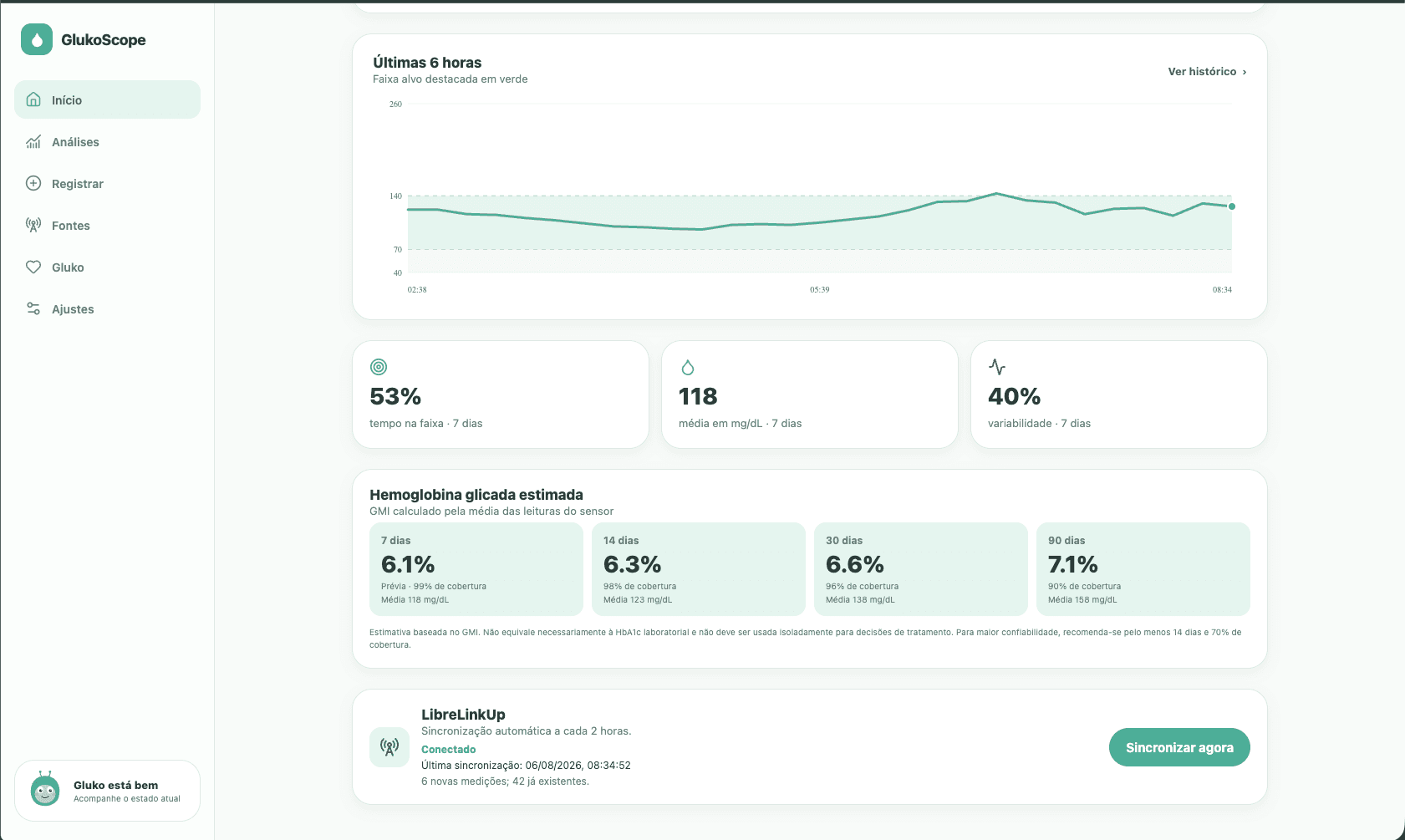
The home view makes the latest reading and personal target visible first, then pairs them with a short-term chart, time in range, average glucose, variability and estimated GMI windows. A dedicated analysis view lets a person choose a period and inspect coverage, lows, highs, a daily profile and the measurement history that produced those summaries.
Those indicators are intentionally framed as descriptive. The product can show trends and explain its estimates, but it does not make treatment decisions. Gluko, the companion that reacts to the current state and trend, gives the experience a more human rhythm without pretending to replace professional guidance.
Using AI to shape a coherent product language
The first web layout was created with v0 by Vercel. I used AI as a design collaborator to explore the visual identity, then turned the useful directions into a design system: color tokens, typography, spacing, radii, surface treatment and states for charts, targets and Gluko reactions.
That system is what lets the dashboard, analytics, source connections and the companion feel like parts of one product rather than separate screens. It also became shared interface primitives: buttons have defined primary, secondary and outline variants, with consistent dimensions and explicit pressed, loading and disabled states. The implementation still required product judgment: deciding what to emphasize, where to reduce cognitive load and how to keep the experience useful without making clinical claims.
Security needs a calm recovery path
A personal-health product still needs ordinary account flows to feel dependable. Account creation checks a strong password policy: at least 12 characters, uppercase and lowercase letters, a number and a symbol, with visible confirmation before the account is created. Password fields support the expected visibility control and browser password-manager semantics.
Password recovery is a complete flow rather than a dead-end link: the recovery email returns through the authentication callback to a dedicated update-password screen. The product tracks that the recovery flow was requested or completed, but never records a password or its contents. This is a small detail in a roadmap, yet it is central to the trust required to return to personal health data over time.
LibreLinkUp is part of the product today
Manual tracking remains available, but LibreLinkUp is already implemented as a real integration. From the Sources area, a person can connect the account, initiate a sync and keep manual entries alongside imported readings. The first synchronization imports the available recent history; later runs deduplicate readings before they reach the timeline.
The integration lives entirely behind the API. Credentials are encrypted with AES-256-GCM, synchronization activity is auditable and the adapter can be disabled per environment. The current service can also refresh on a configured interval while the backend is running, with a separate CSV import path for a fuller LibreView history.
Privacy and product boundaries belong together
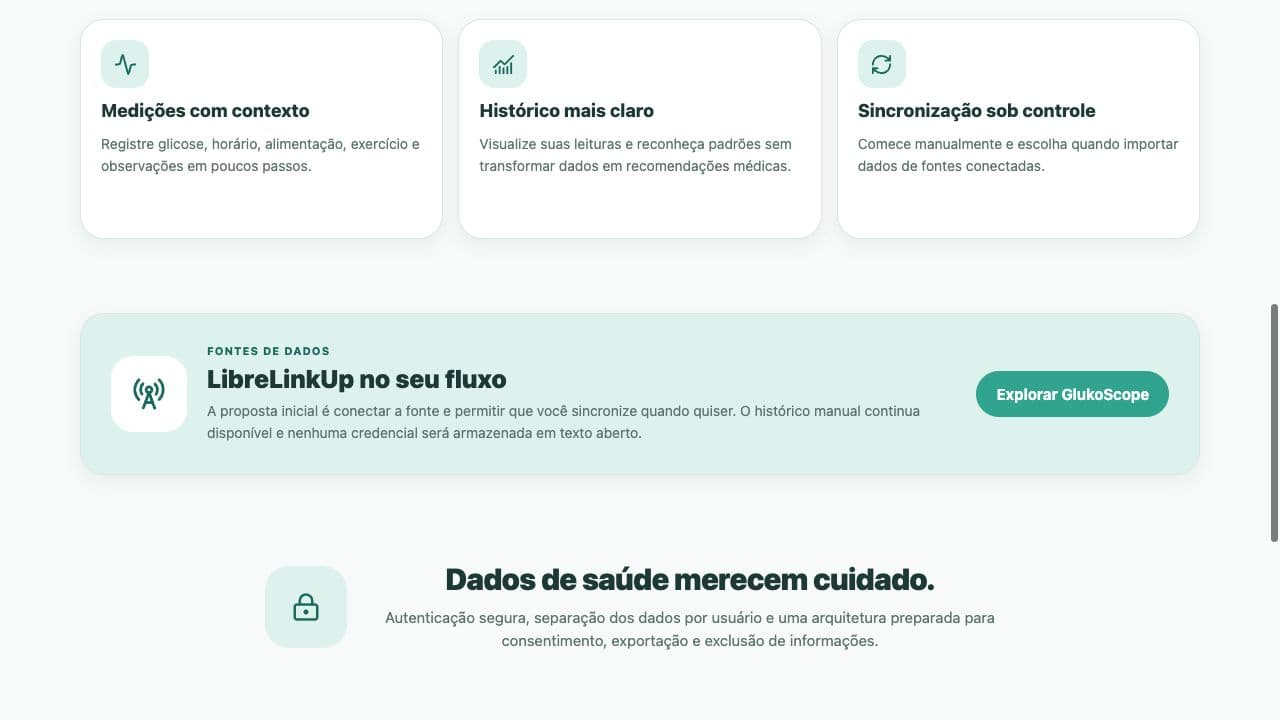
Glucose readings are sensitive health data, so the architecture treats privacy as a product capability rather than a legal afterthought. Authentication, user-level data separation, consent, export, deletion, auditability and data provenance are all explicit concerns in the model.
Analytics is opt-in and offers three choices: decline it, allow it anonymously or allow it linked to the account. Nothing from Amplitude initializes before that choice. Anonymous analytics keeps no account identity, disables IP collection and omits target-range values; the linked mode uses only the internal account identifier, never an email, and sends range limits only when someone saves those settings.
Amplitude Analytics and Session Replay help evaluate navigation and interaction quality, not health behavior. Replay data stays in memory before upload and uses conservative masking. Glucose readings, email, passwords, notes, LibreLinkUp credentials and CSV contents are not sent as event properties. The backend also keeps its stable internal identity separate from the authentication provider, stores measurements in a canonical unit, preserves time in UTC with a user timezone for presentation, and avoids recording glucose values or tokens in application logs.
Designed to evolve without rewriting the core
The stack is a TypeScript monorepo: Expo and React Native for the universal app, Fastify for the API, PostgreSQL and Prisma for persistence, and shared contracts at the boundaries. It starts as a modular monolith so the product can move quickly without coupling its core measurement model to a specific interface or supplier.
LibreLinkUp is the implemented external source. Apple Health, Health Connect and Nightscout are intentionally mapped as future adapters, not presented as current functionality. Keeping those sources behind the same boundary means the product can evolve while preserving its central promise: more context around personal glucose data.